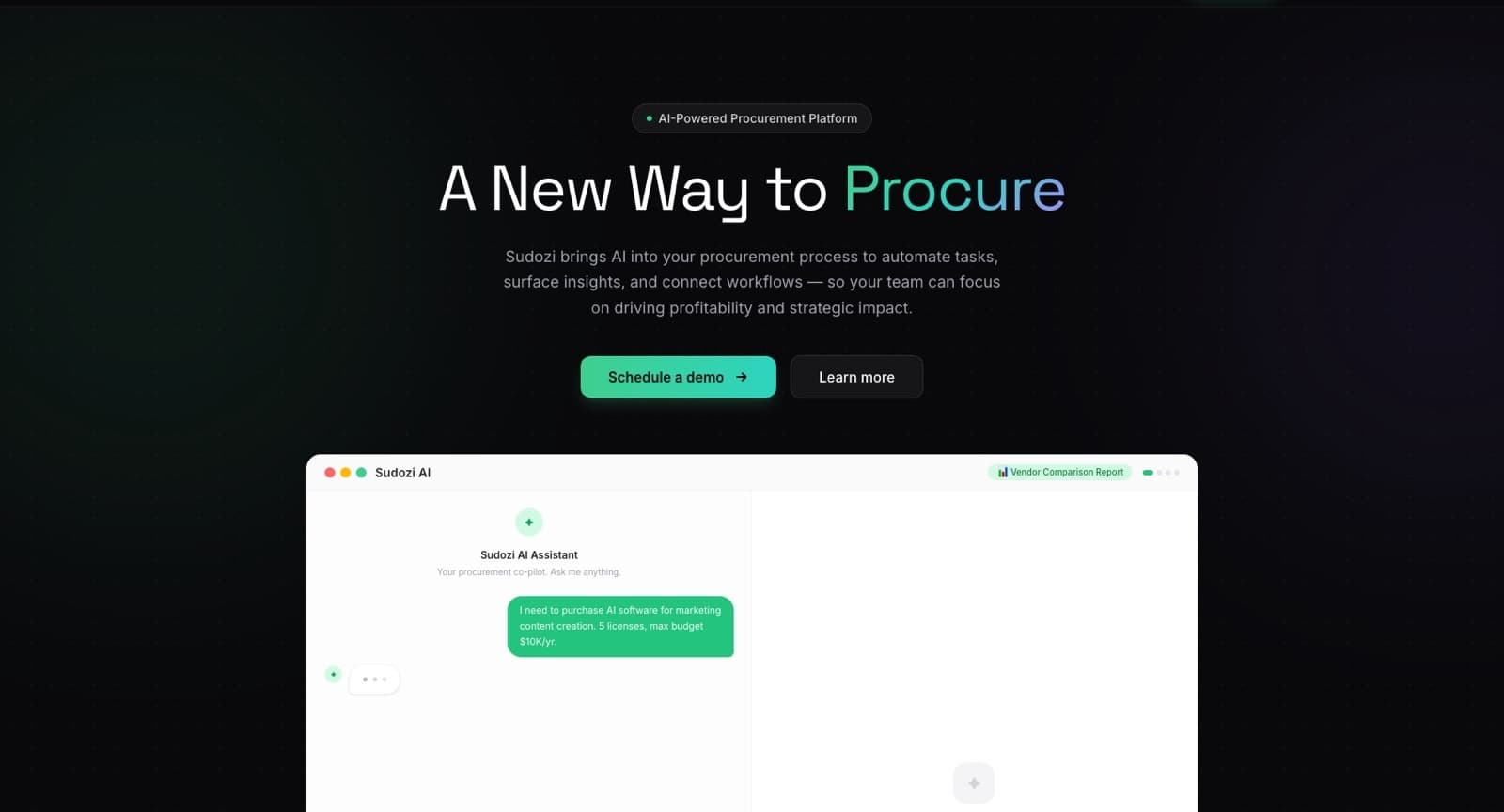
Sudozi
ProcurementOrchestrationPlatform
From zero to 100+ enterprise clients — building the design foundation of a procurement startup
Role
Founding Designer
Duration
2020 – Present
Platform
Web · Enterprise SaaS
Team
CEO, 3 Engineers, 1 Designer (me)
Users
100+ Enterprise Organizations
As the first and only designer, I owned every pixel — product vision, UX research process, information architecture, design system, branding, and marketing. I worked directly with the CEO and engineering to shape what the product became.
Overview
Outcome Snapshot
What shipped, why it mattered, and how impact was measured.
Over 5 years, I designed Sudozi from a rough MVP into an enterprise-grade procurement platform serving 100+ organizations. The core challenge: build one product flexible enough to absorb the wildly different procurement processes of each client — without drowning users in complexity.
Sudozi was a pre-seed startup entering the enterprise procurement space — a market dominated by rigid, legacy tools. With no existing design infrastructure and a small team, every design decision had to earn its place.
100+
Enterprise clients
0→1
Built from scratch
5+
Years of iteration
Challenge
One Product, 100 Different Workflows
Every organization we spoke to had a unique procurement process. Different approval chains, different compliance rules, different data requirements. The first 10 clients each needed custom configurations that our MVP couldn't support.
The real paradox wasn't technical — it was a design problem. How do you build a single interface that feels purpose-built for each organization, without becoming an unusable settings panel?
- Rigid Market — Existing tools forced companies to adapt their process to the software, not the other way around
- Two Audiences — Procurement admins who configure the system and internal buyers who submit requests have fundamentally different mental models
- Scale vs. Customization — Every client wanted bespoke workflows, but custom development for each would never scale beyond 20 clients
Approach
Designing Constraints, Not Options
Early on, I tried building maximum flexibility — every setting exposed, every workflow configurable. The result was a settings page that terrified new admins. User testing with the first 10 clients revealed that 80% of configuration patterns fell into 5 common archetypes.
This insight reframed the entire design strategy: instead of building infinite options, I designed smart defaults around common patterns and only exposed configuration where variation actually mattered. Progressive disclosure became the core principle — simple on the surface, powerful underneath.
- Research Foundation — Interviewed 50+ procurement teams across industries to map common workflow patterns
- Archetype-Based Defaults — 5 workflow templates covering 80% of use cases, reducing initial setup from days to hours
- Progressive Disclosure — New admins see a simple setup wizard; power users unlock advanced configuration over time
- Two-Portal Architecture — Completely separate but data-connected interfaces for admins and requesters, each optimized for its audience
Solution
Self-Serving Configuration at Scale
The final system lets procurement admins configure their entire workflow without code — approval chains, custom forms, ERP mappings, routing rules — while requesters interact with a clean, guided experience that hides all that underlying complexity.
The key design decision was treating admin configuration as a visual language: drag-and-drop workflow builders, WYSIWYG form editors, and live previews that show admins exactly what their requesters will see.
- Visual Workflow Builder — Drag-and-drop steps with conditional branching, replacing what used to require engineering tickets
- Dynamic Form Engine — Admins design data collection forms that adapt based on request type, amount, and category
- Live Preview System — Every admin change can be previewed from the requester's perspective before publishing
- Intelligent Routing — Rules engine that auto-routes requests based on configurable criteria, eliminating manual triage
Impact
From MVP to Enterprise Standard
What started as a rough prototype for 3 pilot clients became the platform powering procurement for 100+ organizations. The self-serving configuration model meant we could onboard new clients in hours instead of weeks — and they could evolve their workflows independently.
100+
Enterprise clients
5d→4h
Onboarding time
75%
Faster approval cycles
98%
Customer satisfaction
“Sudozi finally gave us a procurement tool that adapts to how we work, not the other way around.”
Reflection
Key Learnings
01
Designing Constraints is Harder Than Designing Options
Fitting 100 organizations into one product isn't about adding more settings. It's about finding the 5 patterns that cover 80% of cases and designing defaults so good that most clients never need to touch advanced configuration.
02
Two-Sided Systems Require Two Mental Models
Every change an admin makes cascades into the requester experience. I learned to always design both sides simultaneously — sketching the admin configuration and the resulting requester flow in the same session.
03
Founding Designer = Design + Everything Else
At a startup with no design team, my job extended far beyond Figma — user research, customer calls, marketing pages, pitch deck visuals, and occasionally arguing about database schemas with engineers.
04
Enterprise Trust is Earned in Months, Lost in Minutes
A single data error or unexpected UI change can undo months of relationship building. I learned to treat stability and predictability as design features, not just engineering concerns.
Next Project