Pulse
LocalBusinessAcquisitionMarketplace
A map-first marketplace for buying and selling local businesses in Southern California
Role
Design · Engineering
Duration
1.5 Weeks
Platform
Web · Marketplace
Team
Solo — Design & Engineering
Users
Buyers, sellers, and operators in SoCal
I designed and engineered the complete product — map-based discovery UI, custom marker system, listing management, messaging, and the Express API backend. Built with AI as my pair programmer.
Overview
Outcome Snapshot
What shipped, why it mattered, and how impact was measured.
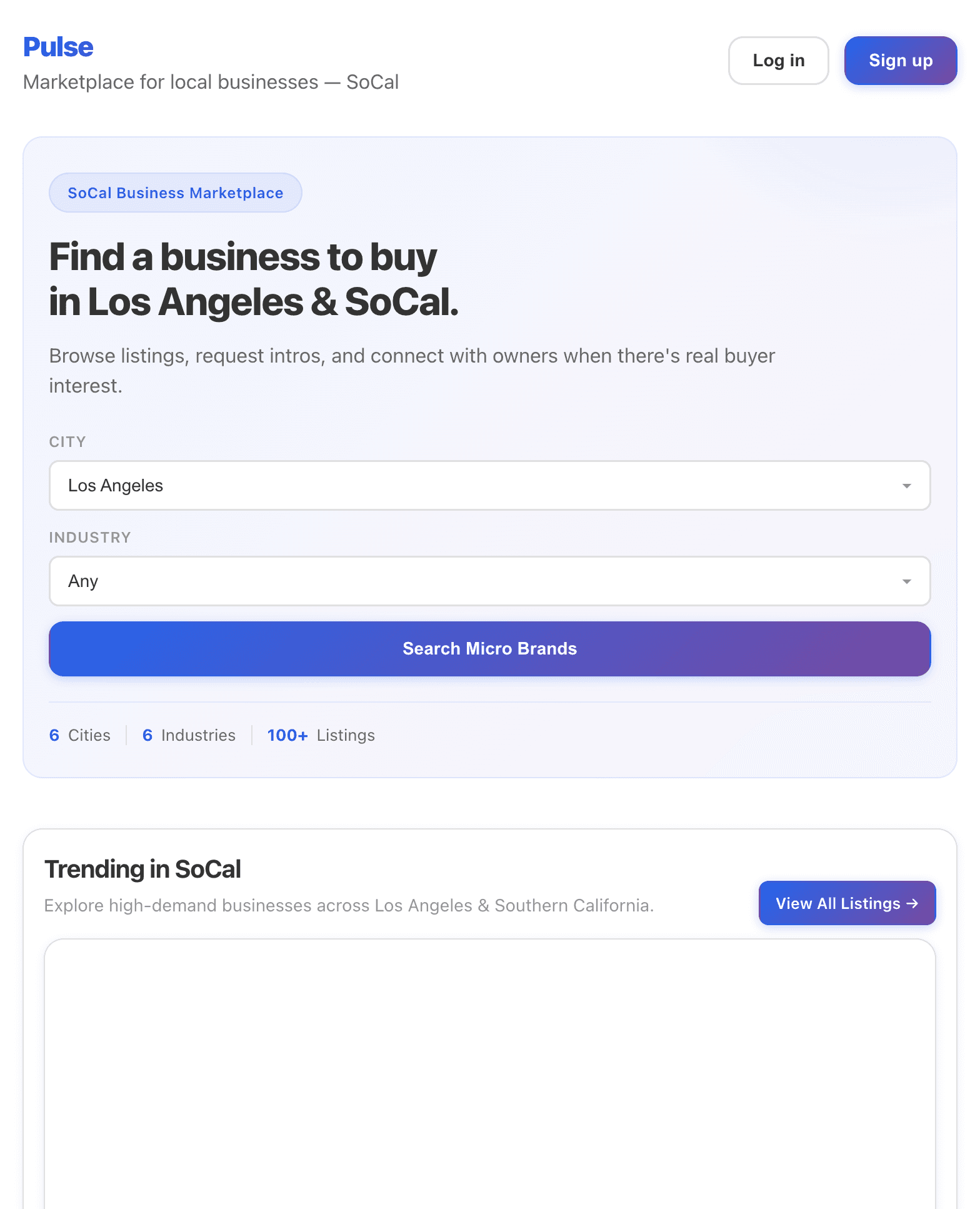
Pulse is a local business acquisition marketplace I designed and built for Southern California. Buyers discover businesses through a map-first interface with custom pill-shaped markers, filter by city and industry, and request introductions to owners. It brings transparency to a market that traditionally operates through brokers and word-of-mouth.
Buying a local business in Southern California means knowing someone who knows someone. Listings are scattered across BizBuySell, Craigslist, and broker websites — each with different formats, stale listings, and no geographic context. The market lacks the transparency and discovery tools that exist for real estate.
6+
SoCal cities covered
10+
Industry categories
E2E
Design & Engineering
Challenge
Local Business Deals Happen in the Dark
The local business acquisition market in Southern California is fragmented and opaque. Listings are scattered across BizBuySell, Craigslist, and individual broker websites — each with different data formats, stale listings, and no geographic context.
Buyers can't browse by neighborhood. Sellers can't gauge demand. There's no equivalent of Zillow for local businesses — no map-based discovery, no standardized listings, no demand signals.
- Fragmented Listings — Deals spread across 10+ platforms with no aggregation or standardization
- No Geographic Context — Buyers think in neighborhoods, but existing tools offer zip code search at best
- Opaque Demand — Sellers have no way to know how many buyers are interested until a broker calls
Solution
Map-First Discovery with Custom Markers
I designed the experience around how buyers actually think: geographically. The split-view interface shows listings on the left and a map on the right. Custom pill-shaped markers display emoji category icons and asking prices directly on the map. Clicking a marker reveals a detailed card. Clustering groups nearby businesses at lower zoom levels.
- Custom pill-shaped map markers (category emoji + price) for instant scannability
- Split-view layout — scrollable list + interactive map on desktop, bottom sheet on mobile
- Multiple deal types — equity sales, business sales, convertible notes, SAFEs
- Micro brands directory — Instagram-driven local businesses with social proof metrics
- City and industry filtering across LA, Santa Monica, Pasadena, Irvine, San Diego, and more
Architecture
React SPA with Express API
Built as a React SPA with Vite for fast development, an Express backend with PostgreSQL, and deep Google Maps integration for custom marker rendering, clustering, and geocoding.
- React 19 + Vite 7 + TypeScript for fast development and HMR
- Express API with PostgreSQL for listings, users, and messaging
- Google Maps API with custom MarkerClusterer and styled pill markers
- Google OAuth + JWT for authentication
- Chart.js for market data visualization and trend analysis
- CSS Modules for scoped, maintainable component styling
Result
SoCal Coverage with Real Listings
Pulse covers 6+ Southern California cities across 10+ industry categories. The platform supports the full discovery-to-contact lifecycle — from browsing the map to requesting an introduction to an owner.
6+
Cities covered
10+
Industry categories
5
Deal types supported
Live
pulsemarket.ai
Reflection
Key Learnings
01
Maps Are the Natural Interface for Local
I tested list-first and category-first layouts before committing to map-first. For local businesses, geography IS the primary filter. Buyers say 'I want a café in Silver Lake,' not 'I want a café anywhere.'
02
Custom Markers Carry Information Density
Standard map pins are useless for marketplace discovery. Pill-shaped markers packing emoji + price into the map layer itself reduced clicks-to-insight dramatically.
03
Full-Stack Ownership Enables Fast Iteration
When the map was sluggish with 200+ markers, I could immediately implement server-side clustering and adjust rendering — a fix that would take multiple sprint cycles in a hand-off workflow.
Next Project