Carta
InvestorUXRedesign
Turning Carta's investor product into a portfolio-first experience through a 3-phase roadmap
Role
Product Designer
Duration
2018 – 2020
Platform
Web · Enterprise SaaS
Team
Investor Services cross-functional team (PM, Engineering, Design)
Users
General Partners, Investment Team members, Investor Operations
I was the solution owner for investor portfolio experience in Carta's Investor Services team, leading research synthesis, IA definition, and end-to-end UX across multiple phases.
Overview
Outcome Snapshot
What shipped, why it mattered, and how impact was measured.
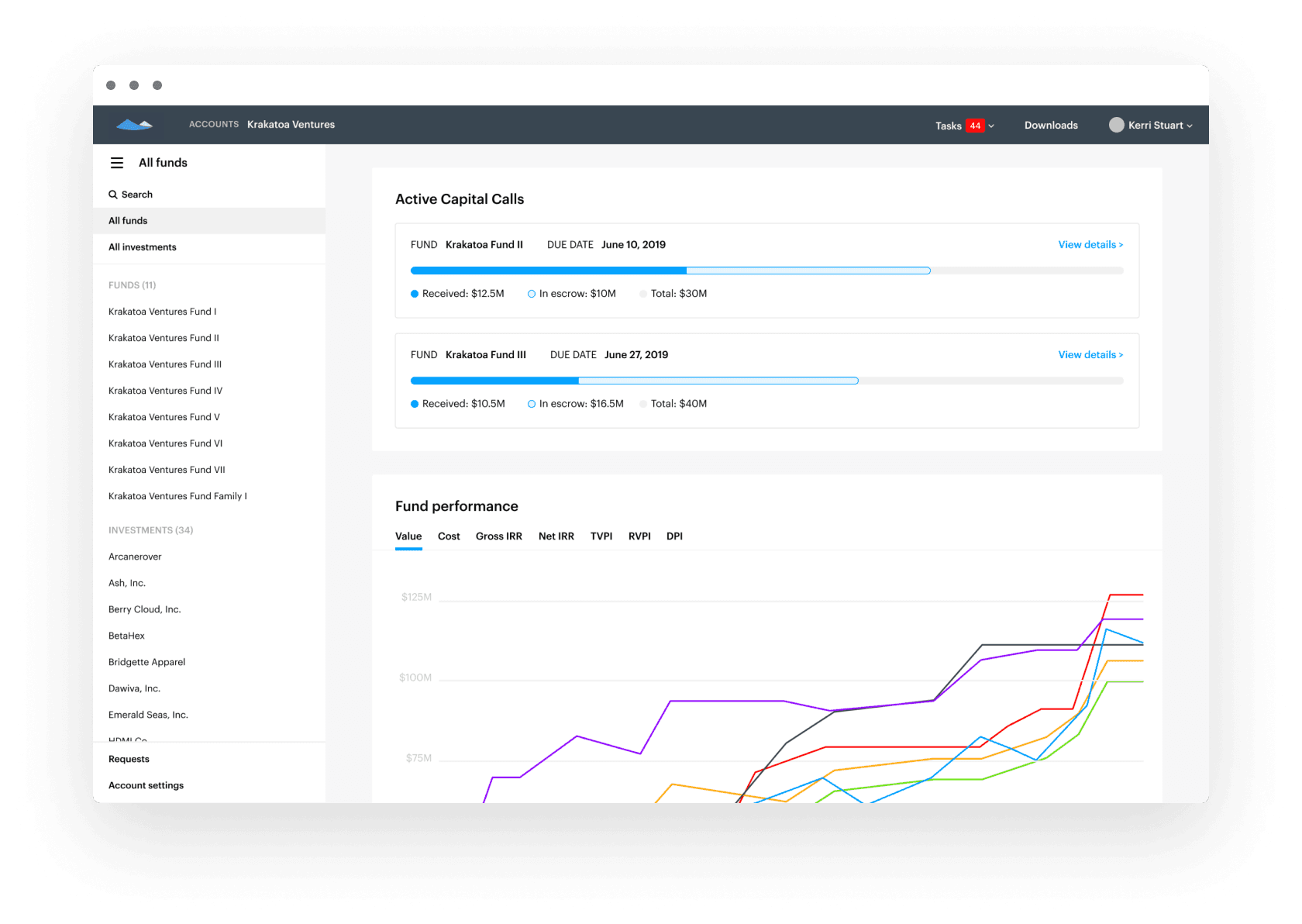
This work evolved from a homepage optimization request into a phased product program: Phase 1 portfolio dashboard, Phase 2 portfolio management, and Phase 3 investor CRM (in progress). The goal across all phases was consistent: make Carta feel like one connected system where investors can move from high-level portfolio review to action-ready details.
Carta had valuable company-level data, but investors needed portfolio-level answers. The product made it hard to see what changed, find answers quickly, and trust portfolio reporting as a source of truth.
3 phases
Dashboard -> Management -> CRM
Phase 1-2
Shipped to production
In progress
Phase 3 IA and WIP screens
Challenge
Company-Level Data Could Not Answer Portfolio-Level Questions
Investors wanted to answer portfolio-level questions in one place, but the existing experience was organized around disconnected company-level views. Critical information existed, yet users still struggled to build a reliable portfolio picture quickly.
The immediate issues were clear in research: investors could not see what changed since their last login, could not quickly find answers, and could not get confidence-building forecast or insight views.
- Change Visibility Gap - Users could not quickly spot what was updated since last session
- Slow Answers - Important portfolio questions required too many navigation jumps
- Limited Insight Layer - Forecast and scenario needs were not supported well
- Weak Landing Context - Legacy logos landing page did not provide bird's-eye portfolio understanding
Strategy
Synthesis Board to Phased Product Strategy
While digging into user interviews, I found that a simple home-page polish would not solve the root issues. We needed a holistic product strategy that connected landing, data management, and future deal workflows.
Working with PM, I mapped a phased roadmap: Phase 1 fixed the landing and visibility issues, Phase 2 addressed portfolio data operations and trust, and Phase 3 extended into investor CRM with pre-deal scenario modeling.
- Research Method - Broke user interview quotes into digestible synthesis board patterns
- Pattern 1 - Each investor firm analyzes portfolio data in a different way
- Pattern 2 - Users needed up-to-date changes and one unified source of truth
- Pattern 3 - Users wanted richer reporting and scenario views for decision making
Phase 1
Portfolio Dashboard V1 Replaced the Legacy Landing Experience
Phase 1 focused on creating a high-value investor landing experience where users could consume data across portfolio companies, customize views, and answer top questions without deep navigation.
I designed the IA and key interactions to make portfolio insights more scannable while keeping the structure expandable for later premium query capabilities.
Success metrics for this release were engagement from General Partners and investment team members on the new page, plus overall GP monthly activity.
- Objective - Replace logos-first landing with portfolio-first dashboard context
- Design Principle - Prioritize minimum viable scope without blocking later scale
- Interaction System - Introduce micro-interactions that surface high-value entry points
- Measurement - Track GP / investment-team engagement and monthly active usage
Phase 2
Portfolio Management Focused on Data Accuracy and Operability
After the dashboard launch, the biggest blocker to trust remained data accuracy. Investors still saw incorrect values when portfolio companies had stale cap table updates, and they had limited control to correct cost/value in workflow.
Phase 2 reframed the problem as portfolio management operations: make entry points easy to find, make cost/value/update state explicit, and reduce support-heavy correction loops across company detail and holdings.
I moved from north-star wireflow to V1 scope and then translated the flow into production-oriented key screens for daily investor operations.
- IA Update - Phase 2 introduced portfolio-management routing within the existing investor structure
- Problem - Incorrect portfolio values reduced product trust as source of truth
- Goal - Clear management workflow for cost, value, and update visibility
- Success Metrics - Reduce support tickets for incorrect data, increase MAU/WAU
- Execution - IA update -> north-star wireflow -> scoped V1 flow -> production key screens
Phase 3
Investor CRM (In Progress): Extending IA for Scenario Modeling and CRM
The next horizon was deal pipeline / investor CRM. Carta had long-term ambition here, but pre-deal workflows were new territory, so we used short design sprints to evolve IA before heavy build-out.
Phase 3 IA expanded scenario modeling and introduced investor CRM pathways (pre-deal companies, notes, update feed, and modeling utilities) while preserving continuity with existing funds/investor navigation.
This phase remains in progress, with WIP CRM screens focused on pipeline visibility, activity tracking, and scenario-modeling entry points.
- Roadmap Context - Phase 3 extends phases 1-2 rather than replacing them
- IA Move - Scenario modeling and investor CRM routes were added to the top-level structure
- Workflow Goal - Connect post-invest portfolio operations with pre-deal CRM exploration
- Current Status - Core IA defined, dashboard and interaction model in active iteration
3 phases
One connected investor roadmap
2 shipped
Dashboard and management delivered
IA extended
Scenario + CRM paths defined
WIP
Investor CRM screens in design sprints
Reflection
Key Learnings
01
Portfolio Questions Need Portfolio-First IA
Strong company-level data is not enough when users think in portfolio terms. IA must reflect the decision level users actually operate at.
02
Phased Delivery Keeps Strategy and Shipping Aligned
Breaking the work into dashboard, management, and CRM phases made it possible to ship meaningful improvements while preserving a coherent long-term architecture.
03
Source-of-Truth UX Requires Editability, Not Just Visibility
Users trust financial products when they can both see and correct critical data through clear operational workflows. Read-only insight alone does not create confidence.
Next Project