Carta
CapitalCallWorkflow
Designing Capital Call & Distribution workflows that fund admins could trust and send
Role
Product Designer
Duration
2018 – 2020
Platform
Web · Enterprise SaaS
Team
1 PM, 4 Engineers, Investor Services partners
Users
Fund Administrators, Investor Services, GPs
I led end-to-end UX for Capital Call and Distribution notice creation inside Fund Admin — from workflow IA and form architecture to dynamic-field templating, review states, and send-ready validation.
Overview
Outcome Snapshot
What shipped, why it mattered, and how impact was measured.
I designed a guided notice workflow for capital calls and distributions so admins could move from draft to review-and-send in one system. The product combined structured data entry, dynamic LP merge fields, and section-level completion states to reduce manual document operations.
Fund admins could track entities and balances in-product, but high-stakes notice documents still required manual drafting and ad hoc workarounds. We needed a workflow that could generate accurate, investor-ready notices directly from structured fund data.
0→1
Notice workflow launched
3
Core steps in flow
LP-scale
Dynamic field personalization
Challenge
Critical Notices Were Still Built Manually
The Fund Admin product handled records, but many capital call and distribution notices still had to be drafted outside the platform. Teams were stitching together templates, hand-editing text, and reconciling values line by line before sending to investors.
That gap created operational risk: inconsistent language across LPs, missed required fields, and extra back-and-forth between investor services, admins, and support.
- Document Gap — Key notice variants could not be fully generated in-product
- Manual Repetition — Similar copy had to be rewritten for each investor communication
- Accuracy Risk — In-kind details and per-investor breakdowns were easy to mis-enter
- No Completion Gate — Teams lacked clear readiness checks before sending notices
Approach
Structured Workflow + Dynamic Content Model
I reframed notice creation as a sequence of constrained steps: capture structured distribution data, compose reusable narrative blocks, then validate completion before review-and-send. The design had to preserve flexibility while preventing incomplete output.
- Step-Gated Progress — Surface required sections as explicit steps with add/edit states
- Dynamic Merge Fields — Let teams inject LP-specific values into standard notice copy
- High-Density Tables — Support in-kind security rows and investor share allocations
- Pre-Send Readiness — Make missing inputs obvious before users can review and send
Solution
Capital Call & Distribution Notice Builder
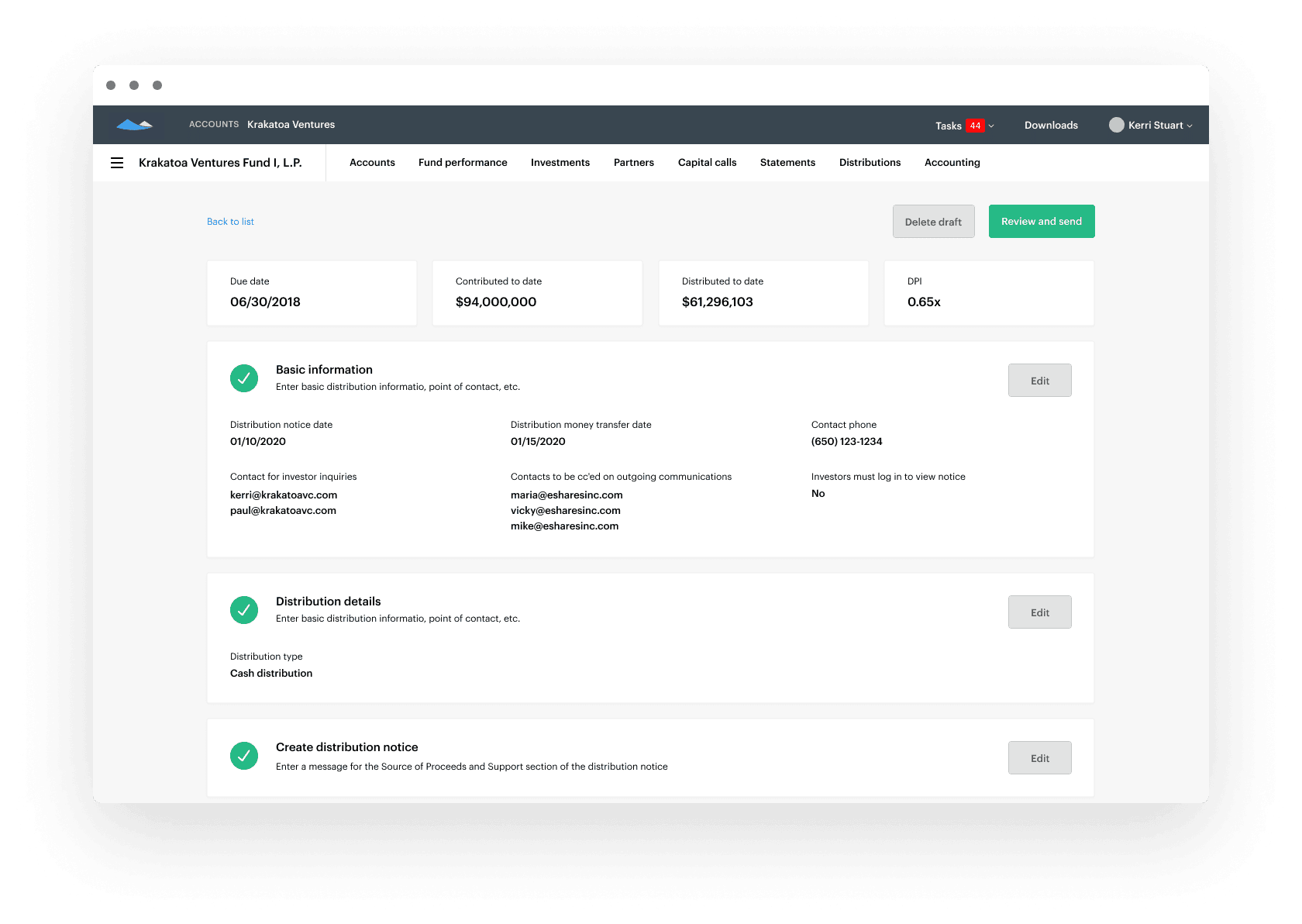
Drafting Surface — Built notice forms for distribution type, in-kind line items, and investor-level allocations with table-first interaction patterns.
Content Editor — Added reusable message sections with dynamic placeholders so long-form legal/operational text could scale across LP communications.
Review State — Designed section-level status cards (incomplete vs complete) so teams could move from draft to review/send with clear operational confidence.
Impact
From Manual Docs to Send-Ready Workflow
The new flow turned notice creation into an auditable product workflow: teams could capture structured inputs, generate investor-facing content, and verify completeness before distribution. Instead of stitching documents externally, admins could complete and send from one path.
3-step
Create → Review → Send
Section
Completion visibility
LP
Dynamic personalization
Single flow
Draft to dispatch
“We finally had a clear path from distribution drafting to a send-ready notice without piecing documents together manually.”
Reflection
Key Learnings
01
Document Workflows Need Product-Grade State
In operations-heavy fintech tools, drafting is not enough. Users need explicit state transitions and completion signals to trust that output is legally and operationally ready.
02
Flexibility Must Be Structured
Admins needed to customize language, but unconstrained text areas created inconsistency. Dynamic-field templates gave flexibility while maintaining correctness and scale.
03
Dense Tables Are a Feature, Not a Smell
For fund operations, table density is core UX. The right move was clear hierarchy and validation around dense data entry, not forcing a low-information interface.
Next Project