Sweetspot
SMBMarketplace&OperationsPlatform
Building an SMB marketplace with full vendor catalog, scheduling, and ERP integration
Role
Design · Engineering
Duration
1.5 Weeks
Platform
Web · Full-Stack SaaS
Team
Solo — Design & Engineering
Users
SMB vendors, operators, and marketplace buyers
I designed and engineered this entire product — information architecture, UI/UX design, frontend (Next.js), backend API (NestJS), database schema, and third-party integrations. Built with AI as my pair programmer.
Overview
Outcome Snapshot
What shipped, why it mattered, and how impact was measured.
Sweetspot is an SMB marketplace platform I designed and built end-to-end. Vendors launch storefronts from a structured catalog, manage fulfillment with built-in scheduling, and sync operational data with ERP systems — replacing fragmented tools with a single workflow.
SMB sellers were operating across disconnected tools: product lists in spreadsheets, order intake in chat apps, scheduling in calendar threads, and inventory/accounting in separate ERP systems. This fragmentation slowed onboarding and made daily operations error-prone.
51+
Marketplace listings
E2E
Design & Engineering
10+
Integrated services
Challenge
SMB Operations Were Fragmented Across 5+ Tools
Small and mid-sized vendors had no unified operating layer. Product data lived in ad-hoc sheets, marketplace listings were manually copied channel by channel, and order scheduling was handled in back-and-forth messages.
Even when businesses had ERP systems, they were hard to connect to front-of-house marketplace workflows. Teams spent time reconciling data instead of selling and fulfilling orders.
- Catalog Fragmentation — No single source of truth for products, variants, and availability
- Scheduling Overhead — Teams coordinated pickups and fulfillment manually in chat
- ERP Disconnect — Inventory and accounting systems were isolated from marketplace operations
Solution
SMB Marketplace Core: Catalog, Scheduling, ERP
I designed a two-sided marketplace system with a full vendor catalog as the source of truth. Vendors could define products, options, and service windows once, then publish and operate from the same data model.
To accelerate adoption, I introduced automated onboarding and gamification. Onboarding prefilled catalog and store settings from a short setup flow, while activation quests rewarded core behaviors (publish first listing, connect ERP, complete first scheduled order) to drive habit formation.
- Full vendor catalog with variants, pricing tiers, and channel-ready listing templates
- Integrated scheduling for pickup/delivery slots and capacity-aware fulfillment planning
- ERP integration layer for inventory and order reconciliation
- Automated onboarding: guided setup, smart defaults, and one-click publish flow
- Gamification: milestone-based activation checklist with progress states and completion rewards
Architecture
Full-Stack Monorepo Architecture
Built as a Turborepo monorepo with a Next.js 15 frontend, NestJS API backend, and shared TypeScript types. Supabase handles auth and database with row-level security for multi-tenant data isolation. Integration services handle ERP sync, payments, and marketplace operations.
- Monorepo (Turborepo) — shared TypeScript types between frontend and backend eliminate drift
- Next.js 15 (App Router) + shadcn/ui for catalog and scheduling workflows
- NestJS backend with Prisma ORM and comprehensive test coverage
- Supabase Auth + PostgreSQL with row-level security for multi-tenant isolation
- ERP connector services for inventory, SKU mapping, and order status sync
- Google Maps for storefront location services and delivery radius
Result
A Living Marketplace
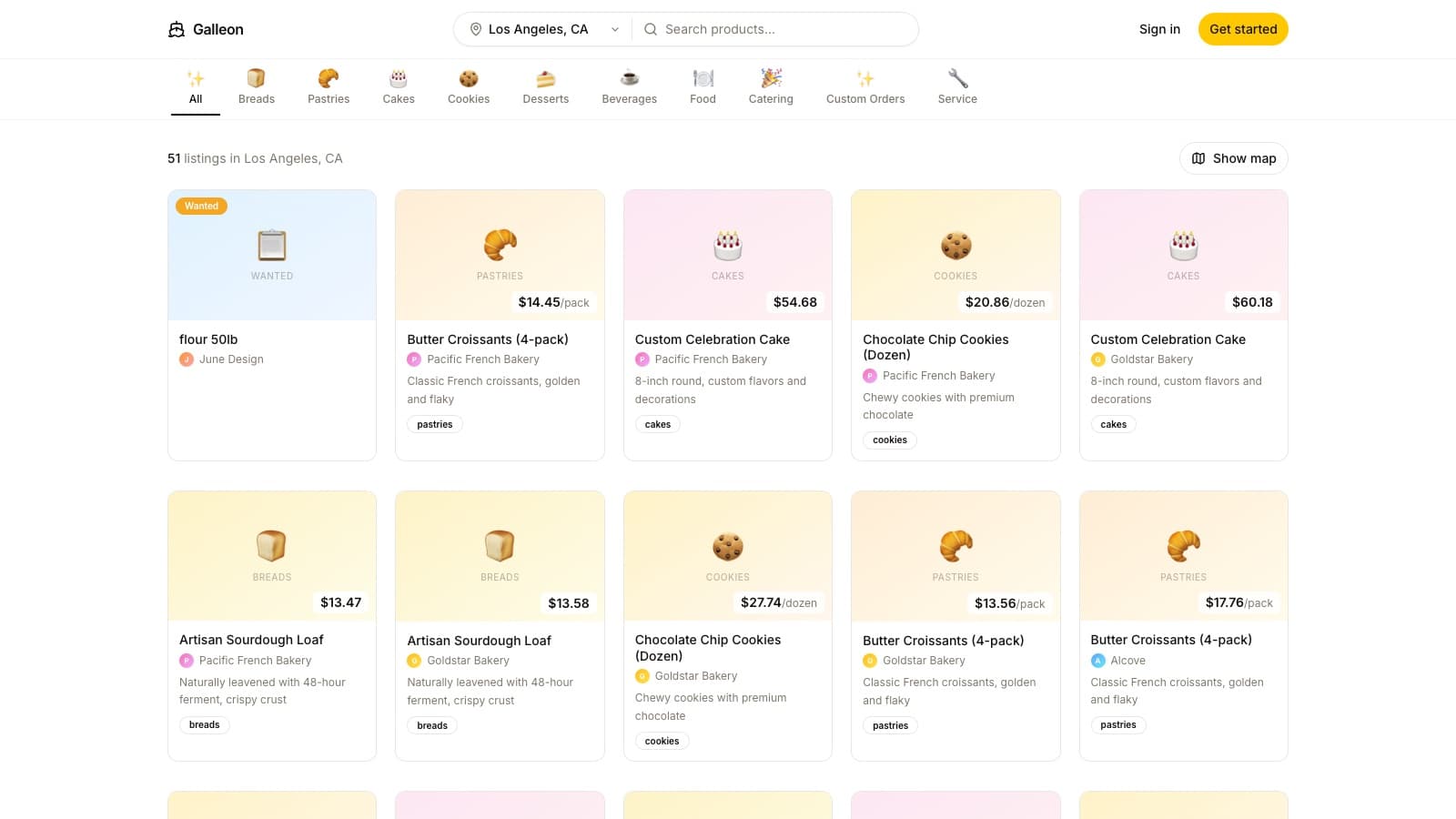
Sweetspot is live at galleon.market with 51+ product listings across Los Angeles. The platform now supports the full SMB flow: catalog setup, automated onboarding, scheduled fulfillment, and ERP-connected operations from one system.
51+
Active listings
10+
Connected services
Full
E2E product lifecycle
Live
galleon.market
Reflection
Key Learnings
01
Automated Onboarding Drives Time-to-Value
Reducing setup friction with smart defaults, progressive steps, and prefilled catalog templates helped vendors publish faster and reduced early drop-off.
02
Gamification Works When It Maps to Real Milestones
Activation quests were effective because each milestone represented an actual business outcome: first listing live, first schedule confirmed, and first ERP sync completed.
03
Cross-System Architecture Shapes UX Quality
Designing and building both frontend and backend exposed integration constraints early, so catalog, scheduling, and ERP behaviors stayed consistent across the product.
Next Project